
At some point, every growing SaaS company has the same meeting. Churn is creeping up, onboarding takes twice as long as it should, renewals are a scramble, and someone says the magic words: “Maybe we should get a consultant in.”
Good idea. But “client success consulting” covers everything from a 90-slide strategy deck to someone who rolls up their sleeves and rebuilds your onboarding pipeline in HubSpot. Pick the wrong one and you pay for a beautiful plan that nobody uses. This guide is here to help you pick the right one.
The short answer: to choose a consultant for client success process redesign, start with the problem you can measure (slow onboarding, missed renewals, churn you can’t explain), then pick someone who will map how work actually happens today, redesign it with your team, build it into your systems and hand it over with documentation. Judge them on practical client success operations experience, hands-on skill in your tools, a clear written scope with deliverables and success measures, and a plan for what happens after they leave.
What client success process redesign actually covers
Process redesign consulting for client success is not “make the CS team work harder”. It’s looking at the whole journey a client takes with you, finding where it breaks, and rebuilding the processes and systems behind it so the team can deliver consistently. In practice, a good engagement usually touches some or all of these:
- Sales to CS handover. What the client was promised, who they are, and what success looks like for them. If this lives in a sales rep’s head, it walks out the door with them.
- Onboarding. Stages, owners, timelines, templates and the point at which a client counts as “live”.
- Adoption and value check-ins. How you know a client is getting value before they tell you they aren’t.
- Customer health. A health score built on signals you actually track, not gut feel and a traffic light someone updates once a quarter.
- Renewals and expansion. When the renewal process starts (hint: not the week before), who owns it, and how upsell opportunities get passed back to sales.
- Escalations and churn. What happens when things go wrong, and how you learn from the clients who leave.
- The systems underneath. Your CRM, help desk, onboarding tool and reporting. If the process is redesigned on paper but the CRM still reflects the old way, the old way wins every time.
That last point is the one most guides skip. A redesigned process that isn’t built into the tools your team opens every morning is a wish list.
Signs you need process redesign (and not just another hire)
Hiring another CSM feels like the obvious fix. Sometimes it is. But if any of these sound familiar, more people will just mean more people working around the same broken process:
- Every CSM onboards clients slightly differently, and the results depend on who you got.
- Renewals regularly surprise you. Nobody saw the churn coming, or the renewal date was spotted three days out.
- You can’t answer “how long does onboarding take?” without someone building a spreadsheet.
- Your health score is green for clients who are about to leave.
- Client information lives in the CRM, the help desk, a shared drive, Slack and a CSM’s notebook.
- Your best CSM is the only one who knows how things really work, and they’ve started looking tired.
- You’ve bought a CS platform, but the team still runs their week from spreadsheets.
If you ticked three or more, the problem is probably the process, not the headcount.
The three types of client success consulting
Before comparing individual consultants, it helps to know which kind you’re looking for. They solve different problems, and none of them is right for everyone.
1. Strategy and advisory firms
Best for big organisational questions: restructuring a large CS department, setting a new operating model, or board-level work. You’ll usually get senior thinking and a polished recommendation. Watch out for whether anyone stays to build it. Ask who does the work after the pitch, because it’s often not the person who pitched.
2. Software implementation partners
Best when you’ve already chosen a platform and need it set up properly. They know the tool inside out. The risk is that they implement your current process faithfully, broken bits and all, because redesigning the process wasn’t in the scope.
3. Hands-on operations consultants
Best for growing B2B and SaaS teams who need both: someone to fix the process and build it into the systems. Usually smaller firms or independents who have run client success or CS operations themselves. The trade-off is capacity. One person can’t run a 40-country transformation, and a good one will tell you so.
Many teams need a bit of type 3 with the clear thinking of type 1. That’s worth saying out loud when you brief people.
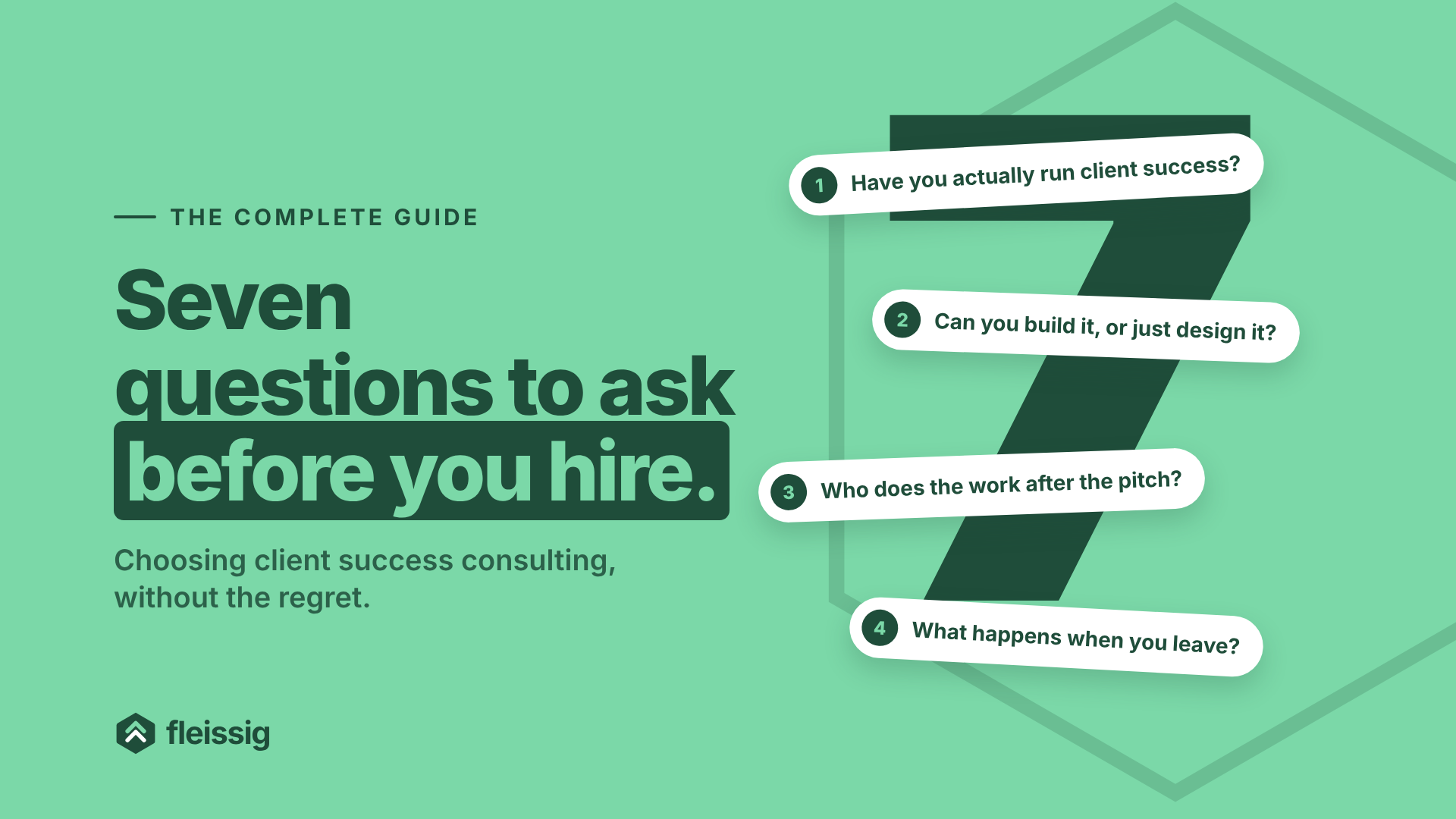
Buying criteria: seven questions to ask any consultant
This is the bit to print out. For each question, here’s what a good answer sounds like and what should make you nervous.
1. “Have you run client success, or only advised on it?”
Good answer: they’ve owned a book of accounts, a renewal number or a CS operations function, and can tell you what went wrong as well as what went right.
Be wary of: frameworks with no war stories. Client success is full of edge cases, and you learn them by living them.
2. “How will you find out how things work today?”
Good answer: interviews with the people doing the work (not just their managers), a look at real records in your CRM, and a walk through a few recent onboardings and renewals end to end.
Be wary of: a discovery phase that is one workshop with leadership. The real process lives with the team, along with all the workarounds.
3. “Who will actually do the work?”
Good answer: a named person, and you’ve met them.
Be wary of: “our team” with no names attached.
4. “Can you build it in our tools, or just design it?”
Good answer: they can configure pipelines, properties, workflows, tasks and dashboards in your CRM (HubSpot, Salesforce, Gainsight or whatever you use), or they’re clear about who will.
Be wary of: “we’ll hand the recommendations to your admin”. If your admin had time, you probably wouldn’t need a consultant.
5. “What will we have at the end?”
Good answer: a list of deliverables you can point to: process maps, the configured system, playbooks, a documented health score, training, and a dashboard showing the measures you agreed.
Be wary of: “a roadmap” as the only deliverable.
6. “How will we know it worked?”
Good answer: two or three measures agreed up front, with a baseline. For example, time to first value, on-time onboarding rate, renewal forecast accuracy or gross revenue retention.
Be wary of: success defined as “alignment” or “visibility”. Lovely words, impossible to check.
7. “What happens when you leave?”
Good answer: documentation in your knowledge base, an internal owner for every process, training for the team and a check-in a few weeks later.
Be wary of: silence, or a monthly retainer as the only answer.
Scope markers: what a good proposal includes
A proposal for client success process redesign should leave you in no doubt about what you’re buying. Look for these, in writing:
- The problem in one or two sentences, in your words, with the measure you’re trying to move.
- Which processes are in scope (for example, handover and onboarding) and, just as importantly, which are not (for example, support ticketing).
- Which systems they’ll touch, and what level of access they need.
- Phases with deliverables: discovery and current-state map, future-state design, build, test with a few real clients, documentation and training, handover.
- Who you need from your side, and roughly how many hours a week. Redesign without your team’s time doesn’t stick.
- Timeline and price, and what happens if the scope changes.
- Success measures and baseline.
As a rough guide, a focused redesign of one or two processes for a small to mid-sized team usually runs a matter of weeks, not months. If a proposal for onboarding alone stretches into next year, ask why.
How client success consulting is usually priced
You’ll mostly see three models. Each fits a different stage.
- A fixed-fee diagnostic or audit. A short, contained look at your processes and systems with a prioritised list of what to fix. Low risk, and a good way to test whether you like working with someone.
- A fixed-scope project. The redesign and build itself, priced on the scope above. Insist on deliverables tied to the price, not just hours.
- Monthly support. Ongoing help once the foundations are in, for continuous improvement, admin and reporting. Useful, but it shouldn’t be the only way to keep the lights on.
Starting with a diagnostic before committing to a bigger project is rarely a bad idea. You find out what actually needs fixing, and they find out whether the problem is what you think it is. (It often isn’t.)
Red flags when evaluating service providers
- They recommend a new tool before they’ve seen your process. Software rarely fixes a process problem. It usually just makes it faster.
- They only want to talk to leadership. See question two.
- The proposal could be for any company. If your name were swapped for a competitor’s and nothing else changed, it isn’t really a proposal.
- Everything is “best practice”. Best practice is a starting point. Your clients, contract model and team size all change what “good” looks like.
- No mention of change management. A new process that the team wasn’t involved in designing is a process the team will quietly ignore.
- They can’t say no. A consultant who takes every scope, every timeline and every budget will struggle to deliver any of them.
A simple scorecard for comparing consultants
If you’re talking to two or three people, score each from 1 to 5 on these. It turns a gut-feel decision into a conversation your leadership team can actually have.
- Hands-on client success experience
- Skill in your specific tools
- Quality of their discovery approach
- Clarity of scope, deliverables and price
- Agreed success measures
- Handover and documentation plan
- How easy they are to work with (did they listen, or did they pitch?)
That last one matters more than it looks. You’ll be sharing your messiest processes with this person. You want someone who finds that interesting, not alarming.
What the first 30 days should look like
Whoever you choose, a good start usually looks like this:
- Week 1: access to systems, interviews with the team, and a look at real client records.
- Week 2: a current-state map, warts and all, plus the two or three biggest causes of pain.
- Week 3: a future-state design agreed with the people who’ll use it.
- Week 4: the first part built and tested with a handful of live clients.
If you’re a month in and still looking at slides, it’s fair to ask when the building starts.
Frequently asked questions
What is client success process redesign?
It’s reviewing and rebuilding the processes your team uses across the client lifecycle (handover, onboarding, adoption, health monitoring, renewals and escalations) and the systems that support them, so clients get a consistent experience and the team isn’t relying on workarounds.
How long does a client success process redesign take?
For a small to mid-sized SaaS team focusing on one or two processes, usually somewhere between four and twelve weeks, including build and handover. A full lifecycle redesign across several teams takes longer.
Should we use a large consulting firm or an independent consultant?
Large firms suit large, multi-region transformations. Independent or small operations consultants usually suit growing B2B teams that need someone to both design the process and build it in their tools. Ask yourself whether your problem is mostly strategic or mostly operational.
Do we need a client success platform before we redesign our processes?
No. Get the process right first. Many teams can run solid client success processes in the CRM they already have, such as HubSpot, and only add a dedicated platform when they’ve outgrown it.
What should we prepare before speaking to consultants?
The problem you want to solve, the measure that shows it, which processes and tools are involved, who on your team will be available, and a rough budget. Recent examples of a client that went well and one that didn’t are gold.
How do we measure whether the consulting worked?
Agree two or three measures before work starts and record a baseline. Common ones are onboarding time, on-time onboarding rate, renewal forecast accuracy, gross revenue retention and the share of clients with an up-to-date health score.
Where I fit in
Full disclosure: I’m one of the hands-on ones. I’m Maria, and Fleissig Consulting is just me. I’ve run client success and CS operations in-house, built client success departments for clients, and turned around a portfolio of accounts that were months behind into on-time delivery. These days I help B2B teams redesign their client success, RevOps and marketing processes and build them properly in their systems, usually HubSpot.
If you’re not sure where to start, my systems health check is from €500 look at your processes and systems, with a short list of what to fix first. Or just tell me what’s broken. I’ll read it properly, herbal tea in hand.